

1. Statement / Concept Overview
A straight line parallel to the y-axis has a constant x-coordinate for all its points.
Such a line has its slope not defined (undefined).
Statement:
The slope of any straight line parallel to the y-axis is not defined.
2. Clear Explanation and Mathematical Derivation
Using Two-Point Formula
Let the line be parallel to the y-axis and pass through two points
[A(x, y₁)] and [B(x, y₂)], where the x-coordinate is the same.
- Change in y-coordinate:
[y₂ − y₁ ≠ 0] - Change in x-coordinate:
[x₂ − x₁ = x − x = 0] - Slope formula:
[m = \dfrac{y₂ − y₁}{x₂ − x₁}] - Substitute values:
[m = \dfrac{y₂ − y₁}{0}]
Since division by zero is not defined, the slope does not exist.
Using Angle of Inclination
- A line parallel to the y-axis makes an angle
[\theta = 90°] with the positive x-axis.
Using the formula:
[m = \tan \theta]
[m = \tan 90°] → not defined
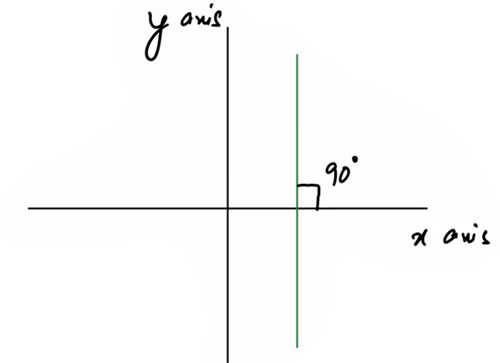
Equation-Based Understanding
The general equation of a line parallel to the y-axis is:
[x = c], where [c] is a constant.
Here, x does not change with y, hence the slope is undefined.
3. Key Features
- Line is perfectly vertical
- x-coordinate remains constant
- Infinite rise for zero run
- Never cuts the y-axis unless [c = 0]
- Represents equations of the form [x = c]
4. Important Formulas to Remember
| Description | Result |
|---|---|
| Line parallel to y-axis | Slope not defined |
| Angle with x-axis | [\theta = 90°] |
| Equation of line | [x = c] |
5. Conceptual Questions with Detailed Solutions
1. Why is the slope of a line parallel to the y-axis not defined?
Because the change in x-coordinate is zero. Since slope is defined as [\dfrac{\Delta y}{\Delta x}], division by zero is not possible.
2. What is the angle of inclination of a vertical line?
A vertical line makes an angle of [90°] with the positive x-axis.
3. Can a vertical line have a finite slope?
No. A finite slope always requires a non-zero change in x.
4. Is slope not defined the same as slope being infinite?
No. In coordinate geometry, slope of a vertical line is said to be not defined, not infinite.
5. Does a vertical line represent a function of x?
No. For a single x-value, there are infinitely many y-values, so it fails the function test.
6. Is the y-axis a special case?
Yes. The y-axis is the line [x = 0], whose slope is not defined.
7. Can two vertical lines intersect?
No. If they have different x-values, they are parallel and never intersect.
8. Can a vertical line be parallel to the x-axis?
No. Vertical and horizontal lines are perpendicular to each other.
9. What happens to slope if the vertical line shifts left or right?
Slope remains not defined. Only the x-intercept changes.
10. Can slope be calculated using tanθ for a vertical line?
No. Since [\tan 90°] is not defined, slope cannot be calculated.
11. Why does a vertical line have infinite steepness but undefined slope?
Although the line is extremely steep, slope is a numerical ratio. Since the ratio involves division by zero, it is mathematically undefined.
12. Can a line with undefined slope be slanted?
No. Only perfectly vertical lines have undefined slope.
13. How do we recognize a vertical line from its equation?
If the equation is of the form [x = constant], the line is vertical.
14. Can a vertical line pass through the origin?
Yes. The y-axis [x = 0] passes through the origin.
15. Do vertical lines have direction?
Yes. They have direction but no horizontal change.
6. FAQ / Common Misconceptions
1. Vertical line means slope is infinity.
Incorrect. In coordinate geometry, slope is not defined, not infinity.
2. Undefined slope means the line does not exist.
False. The line exists but slope cannot be numerically assigned.
3. x = 3 is not a straight line.
False. It represents a vertical straight line.
4. Vertical lines can be written as y = mx + c.
False. Vertical lines cannot be expressed in slope–intercept form.
5. Vertical and horizontal lines are parallel.
False. They are perpendicular.
6. Slope depends on how steep the line looks.
False. It depends on change in coordinates, not appearance.
7. A line with undefined slope cannot intersect x-axis.
False. It can intersect x-axis at a point.
8. All vertical lines pass through origin.
False. Only [x = 0] passes through origin.
9. Vertical lines cannot be graphed.
False. They are easily graphed as straight vertical lines.
10. Undefined slope means slope is zero.
False. Zero slope corresponds to horizontal lines.
7. Practice Questions with Step-by-Step Solutions
Question 1. Find the slope of the line x = 4.
Step-by-Step Solution:
Given equation: [x = 4]
x is constant for all y.
Change in x-coordinate is zero.
Conclusion:
Slope of the line is not defined.
Question 2. Find the slope of the y-axis.
Step-by-Step Solution:
Equation of y-axis: [x = 0]
x remains constant.
Hence, slope is not defined.
Conclusion:
Slope of the y-axis is not defined.
Question 3. Find the angle of inclination of a line parallel to the y-axis.
Step-by-Step Solution:
A line parallel to y-axis is vertical.
Vertical lines make [90°] with the x-axis.
Conclusion:
Angle of inclination is [90°].
Question 4. Is the line x = −6 parallel to the y-axis? Justify.
Step-by-Step Solution:
Given equation: [x = −6]
x is constant for all y.
Such lines are vertical.
Conclusion:
Yes, the line is parallel to the y-axis and its slope is not defined.
Question 5. Can a line with undefined slope pass through (2, 3)?
Step-by-Step Solution:
A vertical line passing through (2, 3) has equation [x = 2].
This line is vertical.
Hence slope is not defined.
Conclusion:
Yes, a vertical line through (2, 3) has undefined slope.
 Sign in with Google