

1. Concept Overview
At any point on a curve, the tangent is a line that just “touches” the curve locally without cutting it.
The slope of the tangent at a point gives the instantaneous rate of change of the function at that point.
The normal line is a line perpendicular to the tangent line at that same point.
2. Mathematical Definition & Derivation
Let a curve be given by:
[f(x)]
Take a point [(x_1, y_1)] on the curve such that:
[y_1 = f(x_1)]
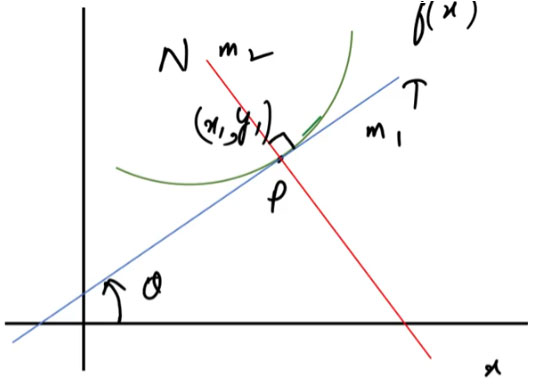
Slope of Tangent
The slope of the tangent at [(x_1, y_1)] is the derivative evaluated at that point:
[\text{Slope of Tangent} ][= \dfrac{dy}{dx}\Bigg|_{x=x_1}]
This represents:
[\boxed{\text{Slope} = \tan\theta}]
where [\theta] is the angle the tangent makes with the positive x-axis.
Slope of Normal
Since tangent and normal are ⟂ (perpendicular):
[m_{\text{normal}} \cdot m_{\text{tangent}} ][= -1]
Thus:
$ \displaystyle {{m}_{{\text{normal}}}}=-\frac{1}{{{{m}_{{\text{tangent}}}}}}$
or
[\boxed{m_{\text{normal}} = -\dfrac{1}{\dfrac{dy}{dx}}}]
3. Important Formulas to Remember
| Line | Slope | Equation passing through [(x_1, y_1)] |
|---|---|---|
| Tangent | [m_t = \dfrac{dy}{dx}] | [y – y_1 = m_t(x – x_1)] |
| Normal | [m_n = -\dfrac{1}{m_t}] | [y – y_1 = m_n(x – x_1)] |
[y – y_1 = \dfrac{dy}{dx}\Big|_{x_1}(x – x_1)] [\quad][ \text{(Tangent Equation)}]
[y – y_1 = -\dfrac{1}{\left(\dfrac{dy}{dx}\right)_{x_1}}(x – x_1)] [\quad][ \text{(Normal Equation)}]
4. Geometrical & Physical Interpretation
- The slope of the tangent [\dfrac{dy}{dx}] shows:
- Steepness of the curve at a point
- Direction of motion in physics
- Instantaneous velocity if [y] is position and [x] is time
- If [\theta] is angle made with +x-axis:
[\boxed{\dfrac{dy}{dx} = \tan\theta}]
5. Key Features
- Tangent gives best linear approximation to the curve at the point
- Normal is always perpendicular to tangent
- If slope of tangent = 0 → tangent is horizontal → normal is vertical
- If slope of tangent is infinite → tangent is vertical and normal slope = 0
- Signs of slopes indicate increasing/decreasing behavior
8. Examples with Step by Step Solutions
Example 1
Find the equations of tangent and normal to the curve [y = x^{2}] at point [x=1].
Step-by-step Solution:
- Compute derivative: [\dfrac{dy}{dx} = \dfrac{d}{dx}(x^{2}) = 2x].
- Slope of tangent at [x=1]: [m_{t} = 2(1) = 2].
- Slope of normal: [m_{n} = -\dfrac{1}{m_{t}} = -\dfrac{1}{2}].
- Point on curve: [y(1)=1^{2}=1] → point [(1,1)].
- Tangent equation: [y – 1 = 2(x – 1)] → [y = 2x -1].
- Normal equation: [y – 1 = -\tfrac{1}{2}(x – 1)] → [y = -\tfrac{1}{2}x + \tfrac{3}{2}].
- Angle of tangent: [\theta = \tan^{-1}(2)] (exact as inverse tangent).
Example 2
Find the equations of tangent and normal to the curve [y = \sin x] at point [x=\tfrac{\pi}{4}].
Step-by-step Solution:
- [\dfrac{dy}{dx} = \cos x].
- Slope of tangent: [m_{t} ][= \cos(\tfrac{\pi}{4}) ][= \dfrac{\sqrt{2}}{2}].
- Slope of normal: [m_{n} ][= -\dfrac{1}{m_{t}} ][= -\dfrac{1}{\sqrt{2}/2} ][= -\sqrt{2}].
- Point: [y(\tfrac{\pi}{4}) ][= \sin(\tfrac{\pi}{4}) ][= \dfrac{\sqrt{2}}{2}] → [(\tfrac{\pi}{4},\ \dfrac{\sqrt{2}}{2})].
- Tangent eqn: [y – \dfrac{\sqrt{2}}{2} ][= \dfrac{\sqrt{2}}{2}\big(x – \tfrac{\pi}{4}\big)].
- Normal eqn: [y – \dfrac{\sqrt{2}}{2} ][= -\sqrt{2}\big(x – \tfrac{\pi}{4}\big)].
- Angle: [\theta ][= \tan^{-1}\big(\dfrac{\sqrt{2}}{2}\big)].
Example 3
Find the equations of tangent and normal to the curve [y = \ln x] at point [x=e].
Step-by-step Solution:
- [\dfrac{dy}{dx} = \dfrac{1}{x}].
- Slope of tangent at [x=e]: [m_{t} = \dfrac{1}{e}].
- Slope of normal: [m_{n} = -e].
- Point: [y(e)=\ln e =1] → [(e,1)].
- Tangent eqn: [y – 1 = \dfrac{1}{e}(x – e)] → [y = \dfrac{1}{e}x]. (Because RHS simplifies: [y-1=\dfrac{x}{e}-1] → [y=\dfrac{x}{e}].)
- Normal eqn: [y – 1 = -e(x – e)] → [y = -ex + e^{2} +1].
- Angle: [\theta ][= \tan^{-1}\big(\dfrac{1}{e}\big)].
Example 4
Find the equations of tangent and normal to the curve [x^{2}+y^{2}=25] at point [(3,4)].
Step-by-step Solution:
- Differentiate implicitly: [2x + 2y \dfrac{dy}{dx} = 0].
- Solve for derivative: [\dfrac{dy}{dx} = -\dfrac{x}{y}].
- At (3,4): [m_{t} = -\dfrac{3}{4}].
- Slope of normal: [m_{n} ][= -\dfrac{1}{m_{t}} ][= -\dfrac{1}{-3/4} ][= \dfrac{4}{3}].
- Tangent eqn: [y – 4 ][= -\tfrac{3}{4}(x – 3)] → [4(y-4) = -3(x-3)].
- Normal eqn: [y – 4 ][= \tfrac{4}{3}(x – 3)].
- Angle: [\theta ][= \tan^{-1}(-\tfrac{3}{4})] (negative angle → descending tangent).
Example 5
Find the equations of tangent and normal to the curve [y = x^{3} – 3x + 2] at point [x=1].
Step-by-step Solution:
- [\dfrac{dy}{dx} = 3x^{2} – 3].
- At [x=1]: [m_{t} ][= 3(1)^{2} – 3 = 0]. → horizontal tangent.
- Slope of normal: tangent slope 0 ⇒ normal is vertical ⇒ slope undefined.
- Point: [y(1)=1 – 3 + 2 = 0] → [(1,0)].
- Tangent eqn: horizontal line [y = 0].
- Normal eqn: vertical line [x = 1].
6. Conceptual Questions with Solutions
1. What does slope of tangent represent physically?
It represents the instantaneous rate of change — like velocity if y is displacement and x is time.
2. What is the slope of tangent if the tangent is horizontal?
Slope = 0 because horizontal lines make angle 0° → [\tan0° = 0].
3. What is the slope of the normal if slope of tangent is 0?
Normal becomes vertical → slope is undefined (or infinite).
4. Why is normal slope -1/(tangent slope)?
Because tangent ⟂ normal → slopes satisfy [m_1 m_2 = -1].
5. What does negative slope of tangent indicate?
Function is decreasing at that point.
6. Which is easier to compute: tangent or normal slope?
Tangent slope (just derivative). Normal slope is derived from tangent slope.
7. If [\dfrac{dy}{dx} > 0], what is the angle θ?
[\theta] lies between 0° and 90° or 180° and 270° (tangent rising).
8. Can a curve have a tangent at every point?
No. Sharp corners/cusps do not have defined slopes → derivative doesn’t exist there.
9. What is slope if the tangent is vertical?
Slope = undefined (infinite). Normal will be horizontal.
10. If [\dfrac{dy}{dx} = \tan\theta], then what is θ?
[\theta = \tan^{-1}\left(\dfrac{dy}{dx}\right)].
11. Does slope depend on the entire curve?
No. It depends only on local behavior around that specific point.
12. Is tangent always unique?
Yes, except at cusp or vertical point where derivative fails.
13. What if the derivative is very large?
Then tangent is almost vertical, steep rise.
14. Can tangents intersect the curve at more than one point?
Yes, e.g., tangent to a circle can intersect at two points.
15. How is slope useful in engineering?
Rate of change analysis — speed, stress gradient, optimization, etc.
7. FAQ / Common Misconceptions
1. Is tangent always outside the curve?
False. It can lie inside (e.g., tangent at top of circle).
2. Does derivative equal the angle?
No. Derivative equals [\tan\theta], not the angle directly.
3. Vertical tangent means no tangent?
No. Tangent exists but slope is infinite.
4. Normal must always have negative slope?
No. It depends on tangent slope.
5. If derivative exists, curve must be smooth?
Locally smooth only at that point, not necessarily everywhere.
6. Zero derivative means stationary point always maximum?
Could be minimum or point of inflection too.
7. Tangent must touch only one point?
Not always — special curves allow tangency at more than one point.
8. Negative slope means curve going backward?
No. It means decreasing y as x increases.
9. Normal = inverse of slope of tangent?
Not inverse — **negative reciprocal**.
 Sign in with Google