

1. Statement of the Law or Concept Overview
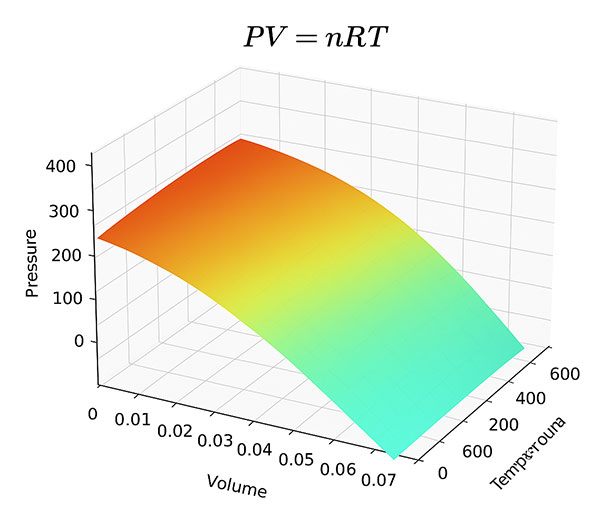
The Perfect Gas Equation (also known as the Ideal Gas Equation) combines Boyle’s Law, Charles’s Law, and Gay Lussac’s Law into a single comprehensive relationship between pressure, volume, and temperature of a given amount of gas.
It is given by:
[ PV = nRT ]
Where:
- [ P ] = Pressure of the gas
- [ V ] = Volume of the gas
- [ n ] = Number of moles of the gas
- [ R ] = Universal gas constant
- [ T ] = Absolute temperature in Kelvin
2. Explanation and Mathematical Derivation
Derivation from the Combination of Gas Laws:
From Boyle’s Law: [ PV] [= \text{constant at constant } T ]
From Charles’s Law: [ \dfrac{V}{T}] [= \text{constant at constant } P ]
From Gay Lussac’s Law: [ \dfrac{P}{T}] [= \text{constant at constant } V ]
Combining the three gives:
[ \dfrac{PV}{T}] [= \text{constant} ]
If we denote the constant as [ R ] per mole of gas, for [ n ] moles:
[ PV = nRT ]
This is called the Equation of State for an Ideal Gas or the Perfect Gas Law.
3. Dimensions and Units
| Quantity | Symbol | SI Unit | Dimensional Formula |
|---|---|---|---|
| Pressure | [P] | [Pa = N/m^2] | [M^1 L^{-1} T^{-2}] |
| Volume | [V] | [m^3] | [L^3] |
| Temperature | [T] | [K] | [K] |
| Gas Constant | [R] | [J mol^{-1} K^{-1}] | [M^1 L^2 T^{-2} K^{-1}] |
4. Key Features
- It holds true for all gases under ideal conditions (low pressure and high temperature).
- The constant [ R ] is the same for all gases.
- It relates macroscopic properties ([ P, V, T ]) of gases.
- The equation provides a link between microscopic behavior (molecules) and macroscopic measurements.
- It forms the basis for the kinetic theory of gases.
5. Important Formulas to Remember
| Expression | Description |
|---|---|
| [ PV = nRT ] | Perfect Gas Equation |
| [ PV = RT ] | For one mole of gas |
| [ P_1V_1/T_1 = P_2V_2/T_2 ] | General gas equation for same gas under different conditions |
| [ R = 8.314 Jmol^{-1}K^{-1} ] | Universal Gas Constant |
| [ R = \dfrac{pV}{T} ] | For 1 mole of gas |
6. Conceptual Questions with Solutions
1. Why is the gas called “perfect” or “ideal” in this equation?
Because it assumes no intermolecular forces and that the volume of individual gas molecules is negligible compared to the volume of the container.
2. What happens if we increase the temperature of a gas at constant pressure?
According to [ PV = nRT ], if [ P ] is constant, [ V ] increases with [ T ]. The gas expands on heating.
3. How does the equation explain Boyle’s Law?
At constant temperature ([ T ] constant), [ PV = nRT = constant ], hence [ PV = constant ], which is Boyle’s Law.
4. What is the significance of the universal gas constant R?
It connects the energy scale with temperature and has the same value for all ideal gases.
5. How does the Perfect Gas Equation relate to Charles’s Law?
At constant pressure ([ P ] constant), [ V \propto T ], which is Charles’s Law.
6. Can the ideal gas equation be used for real gases?
Only approximately — real gases deviate at high pressure and low temperature.
7. Why does the ideal gas equation fail at very low temperatures?
Because intermolecular forces become significant and gases start to liquefy.
8. What is the value of R in different units?
[ R = 8.314\,J\,mol^{-1}\,K^{-1} = 0.0821\,L\,atm\,mol^{-1}\,K^{-1} = 1.987\,cal\,mol^{-1}\,K^{-1} ].
9. What happens to pressure if the number of moles doubles at constant volume and temperature?
From [ PV = nRT ], if [ n ] doubles, [ P ] also doubles.
10. Why is temperature always taken in Kelvin in this equation?
Because Kelvin is an absolute scale; it ensures proportionality between [ V ] and [ T ].
7. FAQ / Common Misconceptions
1. Does the Perfect Gas Equation hold for all gases under all conditions?
No, it holds only for ideal conditions (low pressure, high temperature). Real gases deviate.
2. Is R the same for every gas?
Yes, R is a universal constant, same for all ideal gases.
3. Why can’t we use Celsius directly in the gas equation?
Because Celsius doesn’t start from absolute zero, so proportionality in [ V \propto T ] or [ P \propto T ] fails.
4. If pressure is doubled and volume halved, what happens to temperature?
From [ PV/T = constant ], [ (2P \times \dfrac{V}{2})/T’ = PV/T ] → [ T’ = T ]. Temperature remains the same.
5. What happens to R if we take different gases?
It remains constant. The ratio [ PV/T ] for one mole of any ideal gas is always R.
6. Does the gas equation depend on the type of gas?
No, it depends only on the amount (moles), not the type of gas.
7. What happens when temperature approaches zero Kelvin?
Volume approaches zero — but in practice, gases liquefy before reaching 0 K.
8. Why do we call it an “Equation of State”?
Because it relates the state variables (P, V, T) of a gas in equilibrium.
9. Can pressure and volume be negative?
No, both are always positive physical quantities.
10. What are the conditions for ideal behavior?
Low pressure and high temperature — where intermolecular forces are negligible.
8. Practice Questions (with Step-by-Step Solutions)
Q1. A gas has a volume of [ 0.02m^3 ] at [ 27°C ] and [ 1.013 \times 10^5Pa ]. Find the number of moles of gas.
Solution:
Given, [ V = 0.02m^3], [\ P = 1.013 \times 10^5Pa], [T = 27°C = 300K ]
Using [ PV = nRT ]
[ n = \dfrac{PV}{RT}] [= \dfrac{1.013\times10^5 \times 0.02}{8.314 \times 300}] [= 0.81mol ]
Q2. Find the pressure exerted by 2 moles of gas in a 5 L container at 27°C.
Solution:
[ P = \dfrac{nRT}{V}] [= \dfrac{2\times0.0821\times300}{5}] [= 9.85atm ]
Q3. If temperature is doubled and pressure is kept constant, what happens to volume?
Solution:
From [ PV = nRT ], [ V \propto T ]. Hence, volume doubles.
Q4. If both pressure and temperature are doubled, what happens to volume?
Solution:
From [ V = \dfrac{nRT}{P} ],
[ V’ = \dfrac{nR(2T)}{2P} = V ].
Volume remains unchanged.
Q5. 1 mole of an ideal gas occupies 24.6 L at 27°C. Find the pressure exerted.
Solution:
[ P = \dfrac{RT}{V}] [= \dfrac{0.0821 \times 300}{24.6}] [= 1.00atm ]
 Sign in with Google