

1. Statement of the Principle
The Superposition Principle states:
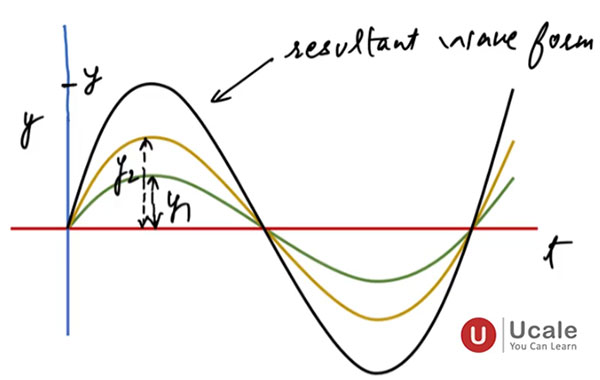
When two or more waves overlap at a point in space, the resultant displacement at that point is equal to the algebraic sum of the individual displacements due to each wave.
Mathematically,
[y_{\text{resultant}}] [= y_1 + y_2 + y_3 + \dots]
This principle is valid for all linear media, where wave equations obey linearity.
2. Clear Explanation and Mathematical Derivation
Basic Idea
When two waves travel through a medium simultaneously, the medium does not choose one wave over the other — instead, it responds to the combined effect of both. If one wave tends to displace a particle upward by ([y_1]) and the other tends to displace it downward by ([y_2]), the particle simply moves to ([y_1 + y_2]).
The principle holds for:
- Mechanical waves (strings, sound)
- Water waves
- Electromagnetic waves (light)
- Quantum waves (probability amplitudes)
Mathematical Derivation (Using Two Harmonic Waves)
Consider two waves traveling in the same direction, with the same frequency [ \omega ] and wave number [k], but possibly different amplitudes and phases:
[y_1] [= A_1 \sin(kx – \omega t)]
[y_2 = A_2 \sin(kx – \omega t + \phi)]
According to superposition:
[y = y_1 + y_2]
Using the trigonometric identity for addition:
[\sin C + \sin D] [= 2 \cos \dfrac{C-D}{2} \sin \dfrac{C+D}{2}]
Applying it here gives:
[y] [= 2 \cos \left( \dfrac{\phi}{2} \right) A_{\text{eff}} \sin \left( kx – \omega t + \dfrac{\phi}{2} \right)]
where the effective amplitude is:
[A_{\text{eff}}] [= \dfrac{1}{2} \sqrt{A_1^2 + A_2^2 + 2A_1A_2 \cos\phi}]
This shows that the resultant wave is still a harmonic wave, but with a new amplitude and a phase shift.
3. Dimensions and Units
| Quantity | Units / Dimensions |
|---|---|
| Displacement (y) | Length ([L]) |
| Amplitude (A) | ([L]) |
| Angular frequency (\omega) | ([T^{-1}]) |
| Wave number (k) | ([L^{-1}]) |
| Phase (\phi) | Dimensionless |
4. Key Features
- Works only in linear media (obeying linear wave equations).
- Resultant displacement is the vector or algebraic sum of displacements.
- Superposition leads to important phenomena:
- Interference
- Beats
- Standing waves
- Diffraction
- Does not imply the waves modify each other — they simply overlap.
- If two waves cancel each other at some instant, this cancellation is temporary.
5. Important Formulas to Remember
| Concept | Formula |
|---|---|
| Resultant displacement | ([y = y_1 + y_2]) |
| Resultant amplitude for two harmonic waves | ([A_{\text{eff}}] [= \sqrt{A_1^2 + A_2^2 + 2 A_1A_2\cos\phi}]) |
| Constructive interference | ([\phi = 2n\pi]) |
| Destructive interference | ([\phi = (2n+1)\pi]) |
6. Conceptual Questions with Solutions
1. Why does superposition occur only in linear media?
Because in linear media, restoring forces obey Hooke’s law, allowing displacements to add algebraically without modifying each other.
2. Can waves pass through each other without disturbing one another?
Yes. They do not collide like particles; they simply add their displacements momentarily and then continue unchanged.
3. Why can two waves cancel each other at a point?
If their displacements are equal and opposite, their algebraic sum becomes zero. The waves themselves continue unaffected.
4. Does destructive interference violate conservation of energy?
No. The energy redistributes — where destructive interference occurs at one point, constructive interference occurs elsewhere.
5. Do amplitudes add directly?
No. Displacements add. Amplitude depends on phase difference and may not equal [A_1 + A_2].
6. Can superposition create a zero resultant wave?
Yes, if the two waves are identical but 180° out of phase.
7. Do frequencies add during superposition?
No. Each wave retains its own frequency. Only displacements add.
8. What happens when two frequencies are close but not equal?
You observe beats — periodic variations in loudness or amplitude.
9. Why is superposition essential for interference?
Interference occurs only when displacement contributions from two waves add at every point in space.
10. Is superposition valid for large amplitudes?
Only if the medium remains linear. Large amplitudes can make the medium nonlinear, breaking superposition.
11. Why can EM waves superpose even in vacuum?
Because Maxwell’s equations are linear, allowing electric and magnetic fields to add vectorially.
12. Can superposition explain standing waves?
Yes. Standing waves are formed by superposing two waves of equal amplitude and frequency traveling in opposite directions.
13. Can energy be entirely canceled by superposition?
No. Energy is redistributed, not destroyed.
14. What if three or more waves overlap?
Superposition still works: all displacements simply add.
15. Do waves need to have the same frequency to superpose?
No. Any waves can superpose; the resultant may be complex (e.g., beats).
7. FAQ / Common Misconceptions
1. “Waves collide and bounce off each other.”
Incorrect. Waves pass through each other; their displacements simply add.
2. “Destructive interference means the waves disappear.”
False. They cancel *temporarily* only at that point; elsewhere they may add.
3. “Superposition happens only for light.”
No. It applies to all waves — sound, water, light, quantum waves, etc.
4. “Amplitude always increases when waves meet.”
Not always. Depending on phase, amplitude may increase, decrease, or cancel.
5. “Superposition changes the properties of the waves.”
No. The individual waves remain unchanged after crossing.
6. “Only two waves can superpose.”
Any number of waves can superpose.
7. “Superposition works even in non-linear media.”
Incorrect. It fails when the medium does not obey linearity.
8. “Beats are produced due to amplitude addition.”
Not exactly — they arise from the phase variation due to slightly different frequencies.
9. “Energy is destroyed in destructive interference.”
No. It redistributes to regions of constructive interference.
10. “Superposition is optional for waves.”
No. It is fundamental — without it, wave behavior (interference, diffraction) would not exist.
8. Practice Questions (with Step-by-Step Solutions)
Q1. Two waves:
([y_1 = 4 \sin(\omega t)])
([y_2 = 3 \sin(\omega t)]).
Find the resultant displacement and amplitude.
Solution:
[y = y_1 + y_2] [= 4\sin(\omega t) + 3 \sin(\omega t)] [= 7\sin(\omega t)]
Resultant amplitude = ([7]).
Q2. Two waves have amplitudes 5 cm and 5 cm and are 180° out of phase. What is the resultant amplitude?
Solution:
[A_{\text{eff}}] [= \sqrt{5^2 + 5^2 + 2(5)(5)\cos\pi}]
[= \sqrt{50 – 50}] [= 0]
Complete cancellation.
Q3. Two waves of equal amplitude interfere such that the resultant amplitude is 1.5 times the original amplitude. Find the phase difference.
[1.5A = A_{\text{eff}}] [= \sqrt{2A^2 + 2A^2\cos\phi}]
[2.25 = 2 + 2\cos\phi]
[\cos\phi = 0.125]
[\phi] [\approx 82.8^\circ]
Q4. Two tuning forks of frequencies 256 Hz and 260 Hz are sounded together. What is the beat frequency?
[f_{\text{beat}}] [= |260 – 256| = 4 \text{ Hz}]
Q5. Show that the resultant of two waves of equal amplitude is maximum when the phase difference is zero.
Solution:
[A_{\text{eff}}] [= \sqrt{A^2 + A^2 + 2A^2\cos\phi}]
Maximum occurs when
[\cos\phi = 1] [\Rightarrow \phi = 0]
giving
[A_{\text{eff}}] [= 2A].
 Sign in with Google