

1. Statement of the Principle / Concept Overview
The Superposition Principle states that:
The net electric force (or electric field) acting on a charge due to a group of charges is the vector sum of the individual forces (or fields) exerted by each charge independently.
It assumes that:
- Charges do not alter each other’s fields.
- Electric field contributions add vectorially, not algebraically.
2. Clear Explanation and Mathematical Derivation
Consider charges [q_1, q_2, q_3, \dots, q_n] producing electric fields at a point P.
Let:
- [\vec{E}_1] = electric field at P due to [q_1]
- [\vec{E}_2] = electric field at P due to [q_2]
- …
- [\vec{E}_n] due to [q_n]
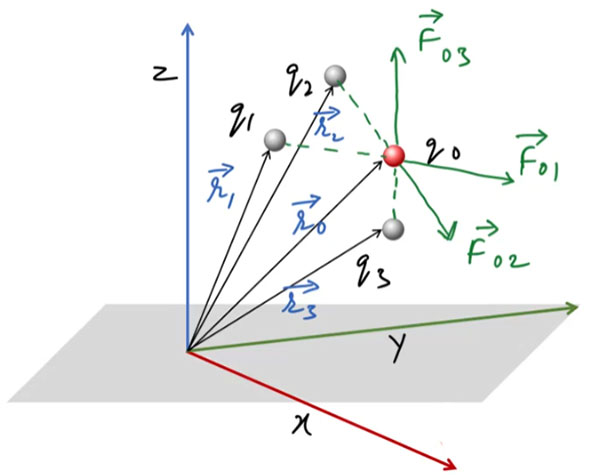
Then the resultant field is:
[\vec{E}_{\text{net}}] [= \vec{E}_1 + \vec{E}_2 + \vec{E}_3 + \dots + \vec{E}_n]
Since
[\vec{E}_i] [= k\dfrac{q_i}{r_i^2}\hat{r}_i,]
we have:
[\vec{E}{\text{net}}] [= k\sum{i=1}^{n}\dfrac{q_i}{r_i^2}\hat{r}_i]
Similarly, for force on a test charge [q_0]:
[\vec{F}_{\text{net}}] [= \vec{F}_1 + \vec{F}2 + \dots] [= q_0\vec{E}{\text{net}}]
3. Dimensions and Units
| Quantity | Dimensions | SI Unit |
|---|---|---|
| Electric Field ([\vec{E}]) | ([MLT^{-3}A^{-1}]) | N/C or V/m |
| Electric Force ([\vec{F}]) | ([MLT^{-2}]) | Newton (N) |
4. Key Features
- Electric fields add vectorially (direction matters).
- Works for any number of charges.
- Holds for static and continuous charge distributions.
- Results remain valid even if charges are very close.
- Fundamental for solving electric field problems in:
- dipoles
- continuous charge distributions
- electric field mapping
- Coulomb force in multi-charge systems
5. Important Formulas to Remember
| Concept | Formula |
|---|---|
| Net Electric Field | [\vec{E}_{\text{net}}] [= \sum \vec{E}_i] |
| Electric Field of a point charge | [\vec{E}_i] [= k\dfrac{q_i}{r_i^2}\hat{r}_i] |
| Net Force on a charge | [\vec{F}{\text{net}}] [= q_0 \vec{E}{\text{net}}] |
| Vector Addition | Apply geometry / components: [\vec{E}_{\text{net}}] [= E_x \hat{i} + E_y \hat{j} + E_z \hat{k}] |
6. Conceptual Questions With Solutions
1. Why do we use vector addition in superposition?
Because electric field and electric force have both magnitude and direction. Scalars add algebraically; vectors add directionally.
2. If two equal positive charges are placed symmetrically about a point, what is the direction of net electric field at the midpoint?
Each field points away from its charge. At the midpoint, both fields are equal and opposite → they cancel. Net field = 0.
3. If two charges produce fields \[E_1\] and \[E_2\] at a point in the same direction, what is the net field?
\[E_{\text{net}} = E_1 + E_2\] because the directions are same.
4. Do charges alter each other’s fields when nearby?
No. Superposition assumes each field exists independently, unaffected by presence of other charges.
5. Can net field be zero even if charges are present?
Yes. If vector fields cancel each other, net field becomes zero though charges exist.
6. Why does superposition greatly simplify field calculations?
Because instead of solving the system collectively, we calculate individual fields and add them vectorially.
7. If three charges produce fields [4\ \text{N/C}], [3\ \text{N/C}], and [5\ \text{N/C}] in mutually perpendicular directions, what is the resultant?
[E] = [\sqrt{4^2 + 3^2 + 5^2}] [= \sqrt{50}] [= 5\sqrt{2}\ \text{N/C}].
8. Does superposition apply to electric potential?
Yes. Potential is scalar, so it adds algebraically: [V = V_1 + V_2 + \dots]
9. Is superposition valid in all media?
Yes, electric field contributions add irrespective of medium.
10. What happens if two fields at a point are equal in magnitude but opposite in direction?
They cancel: \[E_{\text{net}} = 0\].
11. Why do we treat each charge independently?
Because the electric field from one charge exists irrespective of other charges. This independence is fundamental.
12. At a point, fields due to two charges are 8 N/C east and 6 N/C north. Find the net.
[ E_{\text{net}}] [= \sqrt{8^2 + 6^2}] [= 10\ \text{N/C}. ] Direction: [\tan^{-1}(6/8)] [= 37^\circ] north of east.
13. If many small charges produce fields, does the principle still hold?
Yes. It applies to discrete as well as continuous charge distributions.
14. Can forces cancel while fields do not?
Yes. Force depends on test charge: [\vec{F} = q_0\vec{E}]. If test charge = 0, force is zero but field exists.
15. Two equal charges produce fields 10 N/C and 10 N/C at a point but at 120° to each other. Find the net field.
[E] = [\sqrt{10^2 + 10^2 + 2(10)(10)\cos120^\circ}] [= \sqrt{100 + 100 – 100}] [= \sqrt{100}] [= 10\ \text{N/C}.]
7. FAQ / Common Misconceptions
1. Does superposition mean charges do not interact?
No. Charges interact, but their individual fields remain conceptually separable.
2. Is superposition valid for very strong fields?
Yes. Electrostatic fields obey linearity; superposition holds unless in nonlinear media (very rare).
3. Can we add magnitudes of fields directly?
No. Only if they are collinear. Otherwise, vector addition is needed.
4. Does cancellation of fields imply charges disappear?
No. Cancellation only means net field is zero; charges still exist.
5. Is superposition applicable to gravitational field?
Yes. Newtonian gravity is linear; fields add vectorially.
6. Does superposition apply to magnetic fields?
Yes. Magnetic fields also follow vector addition.
7. Does superposition fail if charges move?
For static charges, it fully holds. For rapidly varying charges (electrodynamics), it still applies but with retarded fields.
8. If net field at a point is zero, must the force on any charge be zero?
Yes. Because \[\vec{F} = q\vec{E}\].
9. Can net field be zero at multiple points between two charges?
Only in special symmetric cases. Usually only one point exists.
10. Do positive and negative fields “subtract” automatically?
No. Subtraction comes from vector directions, not from signs of charges alone.
Practice Questions (With Step-by-Step Solutions)
Practice Question 1
Two point charges [q_1] [= +2.0 \times 10^{-6}\ \text{C}] (at [x=0]) and [q_2] [= +2.0 \times 10^{-6}\ \text{C}] (at [x=0.30\ \text{m}]) lie on the x-axis.
Find the net electric field at the point [x=0.60\ \text{m}] (on the x-axis). Give magnitude and direction.
Solution (step-by-step):
- Distance from [q_1] to the point: [r_1 = 0.60\ \text{m}].
Distance from [q_2] to the point: [r_2 = 0.60 – 0.30 = 0.30\ \text{m}]. - Field due to [q_1] at the point (points away from +ve charge ⇒ to the +x direction):
[E_1] [= k \dfrac{q_1}{r_1^2}] [= 9\times 10^{9}\dfrac{2.0\times 10^{-6}}{(0.60)^2}]
Compute: [9\times10^{9}\times 2.0\times10^{-6}] [= 1.8\times10^{4}].
[(0.60)^2 = 0.36].
[E_1 = \dfrac{1.8\times10^{4}}{0.36}] [= 5.0\times10^{4}\ \text{N/C}] - Field due to [q_2] at the point (also points away, i.e. +x):
[E_2] [= 9\times10^{9}\dfrac{2.0\times10^{-6}}{(0.30)^2}]
[(0.30)^2 = 0.09.]
[E_2 = \dfrac{1.8\times10^{4}}{0.09}] [= 2.0\times10^{5}\ \text{N/C}] - Net electric field (same direction, add algebraically):
[E_{\text{net}}] [= E_1 + E_2 = 5.0\times10^{4} + 2.0\times10^{5}] [= 2.50\times10^{5}\ \text{N/C}]
Answer: [2.50\times10^{5}\ \text{N/C}] toward the +x direction.
Practice Question 2
Two point charges [q_1] [= +4.0\times10^{-6}\ \text{C}] at [x=-0.10\ \text{m}] and [q_2 = -4.0\times10^{-6}\ \text{C}] at [x=+0.10\ \text{m}]. Find the net electric field at the origin [(x=0)].
Solution:
- Distance from each charge to origin: [r = 0.10\ \text{m}].
- Magnitude of field from either charge:
[E = k \dfrac{4.0\times10^{-6}}{(0.10)^2}] [= 9\times10^{9}\dfrac{4.0\times10^{-6}}{0.01}]
Numerator: [9\times10^{9}\times 4.0\times10^{-6}] [= 3.6\times10^{4}].
Divide: [\dfrac{3.6\times10^{4}}{0.01}] [= 3.6\times10^{6}\ \text{N/C}.] - Directions at origin:
- Field due to [q_1=+4\mu\text{C}] (at [x=-0.10]) points away from q1 → towards +x. So [E_1] [= +3.6\times10^{6}\ \text{N/C}].
- Field due to [q_2=-4\mu\text{C}] (at [x=+0.10]) points toward q2 → also towards +x. So [E_2] [= +3.6\times10^{6}\ \text{N/C}].
- Net field:
[E_{\text{net}}] [= E_1 + E_2] [= 3.6\times10^{6} + 3.6\times10^{6}] [= 7.2\times10^{6}\ \text{N/C}]
Answer: [7.2\times10^{6}\ \text{N/C}] in the +x direction.
Practice Question 3
A test charge [q_0] [= +1.0\times10^{-6}\ \text{C}] is placed at the midpoint between [q_1] [= +3.0\times10^{-6}\ \text{C}] (at [x=0]) and [q_2] [= -3.0\times10^{-6}\ \text{C}] (at [x=0.20\ \text{m}]). Find the force on [q_0].
Solution:
- Midpoint location: [x=0.10\ \text{m}]. Distances from each charge: [r_1 = r_2 = 0.10\ \text{m}].
- Field at midpoint due to [q_1] (positive):
[E_1 = k\dfrac{3.0\times10^{-6}}{(0.10)^2}] [= 9\times10^{9}\dfrac{3.0\times10^{-6}}{0.01}]
[E_1 = \dfrac{2.7\times10^{4}}{0.01}] [= 2.7\times10^{6}\ \text{N/C}]
Direction: away from q1 ⇒ +x. - Field at midpoint due to [q_2] (negative): field points toward q2. Since q2 is at +x, field at midpoint is also +x with same magnitude: [E_2 = 2.7\times10^{6}\ \text{N/C}].
- Net field:
[E_{\text{net}}] [= E_1 + E_2] [= 2.7\times10^{6} + 2.7\times10^{6}] [= 5.4\times10^{6}\ \text{N/C}] - Force on test charge:
[F = q_0 E_{\text{net}}] [= 1.0\times10^{-6}\times 5.4\times10^{6}] [= 5.4\ \text{N}]
Direction: +x.
Answer: [F = 5.4\ \text{N}] to the +x direction.
Practice Question 4 (Potential — scalar superposition)
Two equal charges [q] [= +2.0\times10^{-6}\ \text{C}] are placed at [x=-0.20\ \text{m}] and [x=+0.20\ \text{m}]. Find the electric potential at the origin.
Solution:
- Potential due to a point charge at distance [r] is: [V = k\dfrac{q}{r}]. Potentials add algebraically (scalar).
- Distance from each charge to origin: [r=0.20\ \text{m}].
- Potential from one charge:
[V_1] [= 9\times10^{9}\dfrac{2.0\times10^{-6}}{0.20}] [= 9\times10^{9}\times \dfrac{2.0\times10^{-6}}{0.2}]
Compute numerator: [9\times10^{9}\times 2.0\times10^{-6}] [= 1.8\times10^{4}.]
Divide by 0.2: [\dfrac{1.8\times10^{4}}{0.2}] [= 9.0\times10^{4}\ \text{V}.] - Since both charges identical and potential is scalar:
[V_{\text{total}}] [= V_1 + V_2] [= 9.0\times10^{4} + 9.0\times10^{4}] [= 1.8\times10^{5}\ \text{V}]
Answer: [1.8\times10^{5}\ \text{V}] at the origin.
Practice Question 5 (2-D vector addition)
Charge [q_1] [= +6.0\times10^{-6}\ \text{C}] is at the origin [(0,0)]. Charge [q_2] [= -2.0\times10^{-6}\ \text{C}] is at [(0.30\ \text{m},,0)]. Find the net electric field at point [P(0,;0.40\ \text{m})]. Give the vector components, magnitude and direction (angle w.r.t +x axis).
Solution:
- Position vectors from sources to P:
- From [q_1]: [(\vec{r}_1 = (0,;0.40))], so [r_1 = 0.40\ \text{m}.]
- From [q_2]: [(\vec{r}_2 = (-0.30,;0.40))] (point P minus q2 position), so [r_2] [= \sqrt{(-0.30)^2 + (0.40)^2}] [= \sqrt{0.09 + 0.16}] [= \sqrt{0.25} = 0.50\ \text{m}.]
- Magnitude of field from [q_1]:
[E_1] [= k \dfrac{6.0\times10^{-6}}{(0.40)^2}] [= 9\times10^{9}\dfrac{6.0\times10^{-6}}{0.16}]
Numerator: [9\times10^{9}\times 6.0\times10^{-6}] [= 5.4\times10^{4}.]
[E_1] [= \dfrac{5.4\times10^{4}}{0.16}] [= 3.375\times10^{5}\ \text{N/C}]
Direction: away from +ve charge → along +y (i.e., vector [(0,;3.375\times10^{5})] N/C). - Magnitude of field from [q_2] (charge is negative → field points toward q2, i.e. along vector from P to q2 which is ((+0.30,,-0.40)) direction):
[E_2] [= k \dfrac{2.0\times10^{-6}}{(0.50)^2}] [= 9\times10^{9}\dfrac{2.0\times10^{-6}}{0.25}]
Numerator: [9\times10^{9}\times 2.0\times10^{-6}] [= 1.8\times10^{4}.]
[E_2] [= \dfrac{1.8\times10^{4}}{0.25}] [= 7.2\times10^{4}\ \text{N/C}]Unit vector from P toward q2:
[\hat{u}_2] [= \dfrac{(0.30,,-0.40)}{0.50}] [= (0.6,,-0.8).]So vector field from [q_2]:
[\vec{E}_2] [= 7.2\times10^{4}\times(0.6,,-0.8)] [= (4.32\times10^{4},,-5.76\times10^{4})\ \text{N/C}.] - Add vectors:
[\vec{E}_{\text{net}} = \vec{E}_1 + \vec{E}_2] [= \big(4.32\times10^{4},;3.375\times10^{5} – 5.76\times10^{4}\big)]
Compute y-component: [3.375\times10^{5} – 5.76\times10^{4} = 2.799\times10^{5}.]So
[\vec{E}_{\text{net}}] [= (4.32\times10^{4},;2.799\times10^{5})\ \text{N/C}.] - Magnitude:
[|\vec{E}|] [= \sqrt{(4.32\times10^{4})^2 + (2.799\times10^{5})^2} \approx 2.83214\times10^{5}\ \text{N/C}] - Direction (angle above +x axis):
[\theta] [= \tan^{-1}!\Big(\dfrac{2.799\times10^{5}}{4.32\times10^{4}}\Big) \approx 81.23^\circ.]
Answer:
[\vec{E}_{\text{net}}] [= (4.32\times10^{4}\ \hat{i} + 2.799\times10^{5}\ \hat{j})\ \text{N/C},]
magnitude [2.83\times10^{5}\ \text{N/C}], at [81.2^\circ] above +x.
Practice Question 6 (Combine many contributions)
Four equal charges, each [+1.0\times10^{-6}\ \text{C}], are placed at the corners of a square of side [0.10\ \text{m}]. Find the electric field at the center of the square.
Solution (sketch with steps):
- By symmetry, fields from opposite corners have same magnitude and directions that combine. Let center be O. Distance from a corner to center: [r] [= \dfrac{\sqrt{2}}{2}\times 0.10] [= 0.07071\ \text{m}.]
- Field magnitude from one charge at center:
[E_{\text{one}}] [= k\dfrac{1.0\times10^{-6}}{r^2}] [= 9\times10^{9}\dfrac{1.0\times10^{-6}}{(0.07071)^2}].
Compute [r^2] [= (0.07071)^2 \approx 0.005].
Numerator: [9\times10^{9}\times1.0\times10^{-6}] [= 9.0\times10^{3}.]
[E_{\text{one}} \approx \dfrac{9.0\times10^{3}}{0.005}] [= 1.8\times10^{6}\ \text{N/C} \ (\text{approx.})] - Direction: each field points radially away from its corner (since charges are +ve). Pairwise, contributions from diagonally opposite corners cancel in perpendicular directions leaving zero net (because four identical symmetric vectors sum to zero).
- By symmetry the net electric field at the center due to four equal charges at corners of a square is zero (all radial components cancel).
Answer: [ \vec{E}_{\text{center}}] [= \vec{0}.]
(Note: step 3 shows why — symmetry causes complete cancellation.)
 Sign in with Google