

1. Concept Overview
When a bar magnet is placed in a uniform magnetic field, it experiences no net force, but it does experience a torque unless its magnetic moment is aligned with the external field.
A magnet has a magnetic dipole moment ([\vec{M}]), directed from its south pole to its north pole.
When placed in a uniform magnetic field ([\vec{B}]), the field tries to rotate the magnet so that its magnetic moment becomes parallel to the field.
The rotational effect is measured by the torque ([\vec{\tau}]).
- If the magnet is parallel to the field → No torque.
- If the magnet is perpendicular to the field → Maximum torque.
- The torque always acts to align the magnet with the magnetic field.
This is similar to the behavior of an electric dipole in an electric field, making the concept easy for beginners to visualize.
2. Clear Explanation and Mathematical Derivation
Consider a bar magnet with:
- Magnetic dipole moment ([\vec{M}])
- Placed in uniform magnetic field ([\vec{B}])
- Making an angle ([\theta]) with ([\vec{B}])
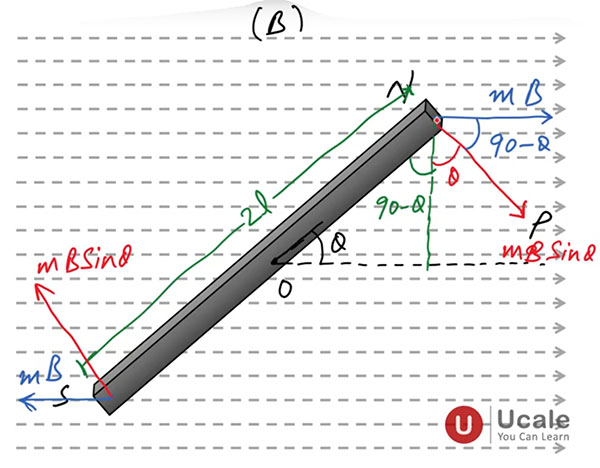
Force on the poles
A bar magnet can be considered as a pair of magnetic poles:
- North pole with pole strength ([+m])
- South pole with pole strength ([-m])
The force on the north pole is:
[
F_N = mB
]
The force on the south pole is:
[
F_S = mB
]
These forces are equal and opposite and form a couple, producing torque.
Torque Calculation
Let the distance between the poles (magnet’s length) be ([2l]).
The perpendicular distance between the forces is:
[
2l\sin\theta
]
Thus, torque:
[\tau] [= F \times ( \text{perpendicular distance} )]
[
\tau = mB(2l\sin\theta)
]
Since dipole moment ([M = 2lm]), we get:
[
\tau = MB\sin\theta
]
Vector Form
[
\vec{\tau} = \vec{M} \times \vec{B}
]
This shows:
- Direction of [\vec{\tau}] is perpendicular to the plane containing [\vec{M}] and [\vec{B}]
- Magnitude is ([\tau = MB\sin\theta])
3. Dimensions and Units
Magnetic Dipole Moment ([M])
- SI Unit: ([\text{A·m}^2])
- Dimension: ([I L^2])
Torque ([\tau])
- SI Unit: ([\text{N·m}])
- Dimension: ([M L^2 T^{-2}])
4. Key Features
- Torque is maximum when ([\theta = 90^\circ]).
- Torque is zero when the magnet is aligned or anti-aligned with (\vec{B}).
- Magnet experiences no net translational force in uniform (\vec{B}), only rotation.
- The direction of torque follows the right-hand rule (for cross product).
- Energy is needed to rotate the magnet against the torque.
- Stable equilibrium: magnet along (\vec{B}).
- Unstable equilibrium: magnet opposite to (\vec{B}).
5. Important Formulas to Remember
| Quantity | Formula |
|---|---|
| Torque on a bar magnet | ([\tau = MB\sin\theta]) |
| Magnetic dipole moment | ([M = 2lm]) |
| Vector form of torque | ([\vec{\tau} = \vec{M} \times \vec{B}]) |
| Condition for zero torque | ([\theta = 0^\circ \text{ or } 180^\circ]) |
| Maximum torque | ([\tau_{\max} = MB]) |
6. Conceptual Questions with Solutions
1. Why does a bar magnet in a uniform magnetic field experience torque but no net force?
Because the forces on the north and south poles are equal in magnitude and opposite in direction, canceling each other. But they act at different points, forming a couple that produces torque.
2. When is torque on a magnet maximum?
When ([\theta = 90^\circ]), i.e., when the magnetic moment is perpendicular to the magnetic field.
3. When is torque zero?
When ([\theta = 0^\circ]) or ([\theta = 180^\circ]), since ([\sin\theta = 0]).
4. What is the physical tendency of this torque?
Torque tends to rotate the magnet so that its dipole moment aligns with the magnetic field.
5. What happens if the magnet is anti-parallel to the magnetic field?
Torque is zero but the equilibrium is unstable. A slight disturbance will rotate it toward alignment.
6. Why is uniform magnetic field important?
In a non-uniform field, the magnet would experience both force and torque, complicating the system.
7. Can torque be negative?
Negative sign indicates direction (clockwise or anticlockwise) relative to chosen axes; magnitude is always positive.
8. Is torque dependent on pole strength?
Yes, because magnetic dipole moment ([M = 2lm]) depends on pole strength.
9. What will happen if magnetic field is zero?
There will be no torque. The magnet remains unaffected.
10. What determines the direction of torque?
The right-hand rule for [\vec{M} \times \vec{B}].
11. Is torque the same for all magnets in a given magnetic field?
No, it depends on the magnetic moment [M] and angle [\theta].
12. Why do compasses work using this principle?
Earth’s magnetic field exerts torque on the compass needle, aligning it along the field direction.
13. Why does torque not depend on the length of the magnet directly?
Because length and pole strength combine into dipole moment [M = 2lm].
14. How does doubling the magnetic field affect torque?
Torque doubles because [\tau \propto B].
15. Why is torque zero when the magnet is parallel to the field?
Because in this orientation, the opposing forces do not produce any turning effect.
7. FAQ / Common Misconceptions
1. Does torque try to rotate the magnet about its geometric center?
No. The axis of rotation is determined by how the magnet is supported or suspended.
2. Does torque act because poles attract or repel?
No. Torque arises due to the couple formed by equal and opposite forces on the poles.
3. Is torque possible if only one pole is inside the magnetic field?
No. Both poles must be in the uniform field region for a pure torque without net force.
4. Does a stronger magnet always have greater torque?
Only if placed in the same field. Torque depends on [M], not on physical size alone.
5. Can a magnet remain perpendicular to the magnetic field?
Only if held by external support; otherwise torque rotates it.
6. Is torque related to magnetic flux?
No. It depends only on [M], [B], and [\theta].
7. Do both poles rotate independently?
No. They are rigidly connected, so the magnet rotates as a whole.
8. Is torque the same as force?
No. Torque is a turning effect; force causes linear motion.
9. Is torque possible in zero magnetic field?
No. Magnetic field is essential.
10. Does torque depend on time?
Not directly; only on angle [\theta] and magnitudes of [M] and [B].
8. Practice Questions (with Step-by-Step Solutions)
1. A bar magnet has dipole moment ([0.4 \text{A·m}^2]). Find torque when placed in a magnetic field ([0.2 \text{T}]) at ([30^\circ]).
Solution:
[\tau = MB\sin\theta] [= 0.4 \times 0.2 \times \sin 30^\circ]
[\tau = 0.08 \times 0.5] [= 0.04 \text{N·m}]
2. At what angle will the torque be half of its maximum value?
[
\tau = \tau_{\max}\sin\theta
]
Half of maximum ⇒
[
\sin\theta = \dfrac{1}{2}
]
[
\theta = 30^\circ
]
3. A magnet experiences torque ([0.25 \text{N·m}]) in a field of ([0.5 \text{T}]). If angle is ([90^\circ]), find dipole moment.
[
\tau = MB
]
[M = \dfrac{\tau}{B}] [= \dfrac{0.25}{0.5}] [= 0.5 \text{A·m}^2]
4. A magnet with dipole moment ([3 \text{A·m}^2]) is aligned anti-parallel to a field of ([0.1 \text{T}]). What is torque?
[\theta = 180^\circ] [,\quad] [\sin\theta = 0]
[
\tau = 0
]
5. A magnet has ([M = 2 \text{A·m}^2]). In what magnetic field will torque be ([0.6 \text{N·m}]) at angle ([45^\circ])?
[
\tau = MB\sin\theta
]
[
0.6 = 2 \times B \times \dfrac{\sqrt{2}}{2}
]
[
0.6 = 2 \times B \times 0.707
]
[
0.6 = 1.414B
]
[
B = 0.424,\text{T}
]
 Sign in with Google