

1. Statement of the Law / Concept Overview
Torricelli’s Theorem states:
The speed of efflux of a liquid flowing out of a small orifice at a depth [h] below the free surface of the liquid is equal to the speed acquired by a freely falling body after falling through the same height [h].
Mathematically,
[v = \sqrt{2gh}]
This result is derived from Bernoulli’s Equation and is a direct application of energy conservation in fluid flow.
2. Clear Explanation and Mathematical Derivation
Consider a tank with a small hole (orifice) at a depth [h] below the free surface.
Let:
- Velocity of the liquid at the free surface = [v_{1} \approx 0] (because area of tank is very large)
- Pressure at the free surface = [P_{0}] (atmospheric)
- Pressure at the orifice = [P_{0}] (jet opens into the atmosphere)
- Velocity of efflux = [v_{2} = v]
- Height difference between free surface and hole = [h]
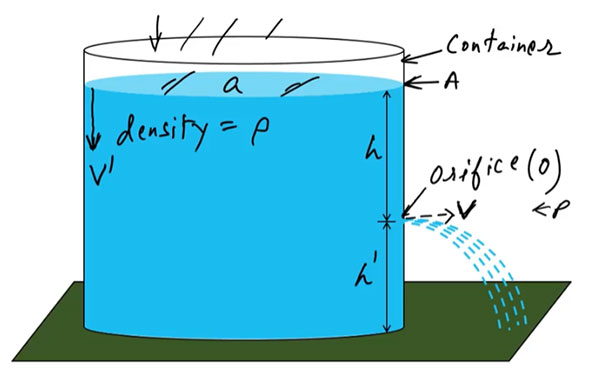
Applying Bernoulli’s Equation
Between the free surface (1) and the orifice (2):
[P_{0} + \rho gh_{1} + \dfrac{1}{2}\rho v_{1}^{2} = P_{0} + \rho gh_{2} + \dfrac{1}{2}\rho v^{2}]
height difference:
[
h_{1} – h_{2} = h
]
Since [v_{1} \approx 0]:
[\rho gh = \dfrac{1}{2}\rho v^{2}]
Cancel [\rho]:
[v = \sqrt{2gh}]
This is Torricelli’s Theorem.
3. Dimensions and Units
[v] = [LT^{-1}] [\quad (\text{SI unit: m/s})]
[h] = [L] [\quad (\text{SI unit: m})]
4. Key Features
- Shows that liquid jets behave like bodies falling under gravity.
- Derived directly from Bernoulli’s theorem.
- Valid for:
- Steady flow
- Incompressible liquids
- Small orifice (so that velocity across it is uniform)
- Independent of the shape of the tank.
- Predicts the jet speed, not the volume flow rate.
5. Important Formulas to Remember
| Concept | Formula |
|---|---|
| Torricelli’s velocity of efflux | [v = \sqrt{2gh}] |
| Height calculation | [h = \dfrac{v^{2}}{2g}] |
| Flow rate through orifice | [Q = A v = A\sqrt{2gh}] |
| Time of fall analogy | Body falling through height [h] has same speed |
6. Conceptual Questions with Solutions
1. Why does velocity of efflux depend on depth?
Because pressure at the orifice increases with depth: \[P = \rho gh\]. Greater depth → greater pressure → greater kinetic energy → higher efflux speed.
2. Why is velocity at the free surface taken as zero?
The tank’s surface area is very large, so surface velocity is negligible compared to jet velocity.
3. Does the shape of the tank affect Torricelli’s velocity?
No. Only the depth \[h\] matters.
4. Why is atmospheric pressure ignored in Torricelli’s equation?
Because both free surface and jet exit are exposed to the same atmospheric pressure, which cancels out.
5. Why is the orifice assumed small?
To ensure velocity is uniform across the opening and streamlines are nearly horizontal.
6. What happens if the opening is large?
Velocity becomes non-uniform, and Torricelli’s theorem does not strictly apply.
7. Why does the jet fall parabolically after exiting?
After exit, only gravity acts → projectile motion → parabolic path.
8. Is viscosity considered in Torricelli’s theorem?
No. It assumes ideal (non-viscous) flow.
9. Does Torricelli’s theorem apply in a vacuum?
Yes, with the same derivation, but practical efflux is usually into air.
10. Does the jet speed depend on the size of the hole?
No. Speed depends only on \[h\], but **flow rate** depends on the area of the hole.
11. Why is the equation similar to free-fall speed?
Both arise from conversion of gravitational potential energy into kinetic energy.
12. What happens to efflux speed if depth doubles?
\[v = \sqrt{2g(2h)} = \sqrt{2}\sqrt{2gh} = \sqrt{2}v\] → increases by factor \(\sqrt{2}\).
13. Does pressure at the free surface matter?
Not for efflux speed, as long as the exit is at same pressure.
14. Does Torricelli apply to gases?
No. It is valid only for incompressible fluids.
15. Why does a deeper submarine need stronger hulls?
Because pressure increases with depth \[\rho gh\], similar to how efflux speed increases with depth.
7. FAQ / Common Misconceptions
1. “Efflux speed depends on the size of the hole.”
No. Speed depends only on depth. Flow rate depends on hole size.
2. “Velocity at the free surface must be considered.”
Not for large tanks. It is negligible.
3. “Larger tanks produce faster jets.”
False. Only depth matters.
4. “Torricelli’s theorem applies to any fluid.”
Only incompressible, non-viscous liquids.
5. “Jet speed is constant after leaving the hole.”
No. After leaving, gravity accelerates or decelerates it depending on direction.
6. “Efflux speed is proportional to depth.”
No. It is proportional to the square root of depth.
7. “Torricelli’s theorem is independent of Bernoulli’s theorem.”
Incorrect. It is a direct application of Bernoulli.
8. “Pressure at the free surface and exit cannot cancel.”
They cancel because both are atmospheric.
9. “The theorem is exact in real fluids.”
Real fluids show losses due to viscosity; actual speed is slightly lower.
10. “Direction of the stream affects velocity of efflux.”
No. Efflux speed depends only on depth, not the direction of the hole.
8. Practice Questions (with Step–by–Step Solutions)
1. Water exits from a hole at depth [0.5 \text{ m}]. Find the efflux speed.
[v = \sqrt{2gh}] [= \sqrt{2(9.8)(0.5)}] [= \sqrt{9.8} = 3.13 \text{ m/s}]
2. A tank has a hole at depth [1.8 \text{ m}]. What is the speed of water emerging?
[v = \sqrt{2(9.8)(1.8)}] [= \sqrt{35.28}] [= 5.94 \text{ m/s}]
3. A jet of water emerges at speed [4 \text{ m/s}]. Find the corresponding depth.
[h = \dfrac{v^{2}}{2g}] [= \dfrac{16}{19.6}] [= 0.816 \text{ m}]
4. A tank drains through a hole of area [2 \times 10^{-4} , \text{m}^{2}] at depth [h = 1 \text{ m}]. Find the volume flow rate.
[v = \sqrt{2gh}] [= \sqrt{19.6}] [= 4.43 \text{ m/s}]
[Q = Av] [= (2 \times 10^{-4})(4.43)] [= 8.86 \times 10^{-4} \text{ m}^{3}/\text{s}]
5. Two holes at depths 1 m and 4 m are opened simultaneously. Compare efflux speeds.
[v_{1} = \sqrt{2g(1)}] [= \sqrt{19.6} = 4.43 \text{ m/s}]
[v_{2} = \sqrt{2g(4)}] [= \sqrt{78.4} = 8.86 \text{ m/s}]
[
\dfrac{v_{2}}{v_{1}} = 2
]
 Sign in with Google