

1. Concept Overview
When you switch on a fan or a bulb, the current in the circuit does not instantly reach its final steady value.
It first builds up slowly, and after a short time, it becomes constant.
Similarly, when you switch it off, the current does not disappear immediately. It takes a little time to fall to zero.
This temporary, short-lived current — which appears only for a small time when a circuit is switched ON or OFF — is called Transient Current.
It happens because inductors and capacitors oppose sudden changes in current or voltage. So the circuit needs a little time to adjust, and during this period, the current is said to be transient.
2. Clear Explanation and Mathematical Derivation
What is a Transient?
A transient is a temporary change in current or voltage before the circuit reaches its steady state.
In AC and DC circuits, transients occur mainly due to:
- Inductors, which oppose sudden change in current
- Capacitors, which oppose sudden change in voltage
We study transient current mostly in LR circuits (inductor + resistor).
(A) Growth of Current in an LR Circuit
Consider a series LR circuit connected to a battery of emf ([E]).
Using Kirchhoff’s law:
[
E = iR + L\dfrac{di}{dt}
]
Solving the differential equation gives:
[i(t) = I_0 \left(1 – e^{-\dfrac{R}{L}t}\right)]
where
([I_0 = \dfrac{E}{R}]) is the maximum (steady) current.
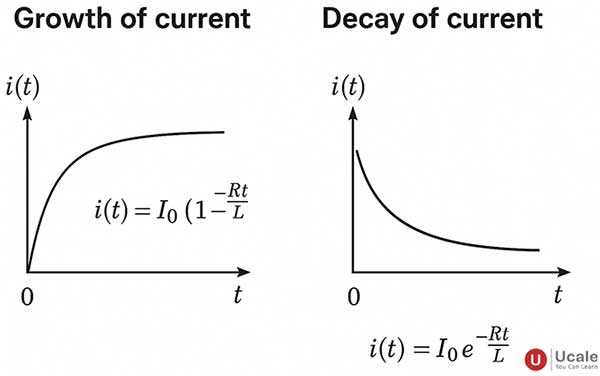
(B) Decay of Current in an LR Circuit
When the battery is disconnected:
[
L\dfrac{di}{dt} + iR = 0
]
Solution:
[
i(t) = I_0 e^{-\dfrac{R}{L}t}
]
Here, ([I_0]) is the initial current at the instant the circuit is opened.
Time Constant (τ)
[
\tau = \dfrac{L}{R}
]
It represents the time in which the current:
- reaches 63% of its final value (during growth)
- falls to 37% of its initial value (during decay)
A large ([L]) or small ([R]) means slower rise or fall of current.
3. Dimensions and Units
| Quantity | Expression | Dimensions | SI Unit |
|---|---|---|---|
| Inductance | [L] | ([ML^2T^{-2}A^{-2}]) | Henry (H) |
| Resistance | [R] | ([ML^2T^{-3}A^{-2}]) | Ohm (Ω) |
| Time constant | [\tau = \dfrac{L}{R}] | ([T]) | second |
| Current | [i(t)] | ([A]) | Ampere |
4. Key Features
- Transient current exists only for a short time after switching.
- It arises mainly due to inductance (in LR circuits).
- Current does not change instantly; it follows an exponential curve.
- The time constant ([L/R]) controls how fast or slow the transient dies out.
- After sufficient time (about (5\tau)), the circuit reaches steady state.
- Growth curve: exponential rise.
- Decay curve: exponential fall.
5. Important Formulas to Remember
| Concept | Formula |
|---|---|
| Growth of current | ([i(t) = I_0 (1 – e^{-Rt/L})]) |
| Decay of current | ([i(t) = I_0 e^{-Rt/L}]) |
| Steady current | ([I_0 = E/R]) |
| Time constant | ([\tau = L/R]) |
| 63% growth time | [t = \tau] |
| 37% decay time | [t = \tau] |
6. Conceptual Questions with Solutions
1. Why doesn’t current in an inductor rise instantly when a switch is closed?
Because an inductor opposes any sudden change in current by producing back emf [L\dfrac{di}{dt}]. Hence current rises gradually.
2. Why is transient current temporary?
It exists only until the circuit reaches its steady state. After that, current becomes constant and the transient disappears.
3. Why does current decay slowly when an LR circuit is switched off?
Because the inductor releases its stored magnetic energy gradually, preventing a sudden fall in current.
4. What does a large time constant mean?
A large [L/R] means slower rise and slower decay of current.
5. Why does resistance affect the transient time?
Greater resistance means faster energy loss, so the circuit reaches steady state more quickly.
6. Why is the growth of current exponential?
Because the equation contains a first-order differential term leading to exponential solutions.
7. Why does an inductor store energy?
It stores energy in its magnetic field: [U = \dfrac{1}{2} L I^2].
8. Why is τ called the time constant?
Because it gives the characteristic time in which current changes significantly (63% rise or 37% fall).
9. Why does current reach 63% of its final value at t = τ?
Substituting [t = \tau] in [i = I_0(1 – e^{-1})] gives [i = 0.63 I_0].
10. Why does an open LR circuit still momentarily have current?
Because the collapsing magnetic field induces emf that maintains current briefly.
11. Why does exponential decay never reach zero instantly?
Because mathematically, ([e^{-x}] approaches zero gradually but never abruptly.
12. Does transient current occur in AC circuits?
Yes. Whenever switching happens, or during phase changes, transients appear briefly.
13. Why is transient current important in electronics?
It helps understand switching behaviour, surge currents, and protection circuits.
14. Do capacitors also cause transients?
Yes. Capacitors oppose sudden changes in voltage, causing voltage transients.
15. Why is transient current faster in small inductors?
Because small inductance means smaller time constant, so current changes more quickly.
7. FAQ / Common Misconceptions
1. Does transient current last for a long time?
No. It lasts for only a few time constants (usually microseconds to seconds).
2. Is transient current harmful?
It can be, because sudden currents can damage components, so surge protectors are used.
3. Does an inductor stop current from flowing?
No. It only opposes sudden change, not steady current.
4. Does current rise linearly in LR circuits?
No. It rises exponentially.
5. Is back emf always present in an LR circuit?
No. It is present only when current changes.
6. Does removing the battery instantly remove current?
No. Inductor maintains current for a short time.
7. Can transient current be zero?
Yes. After the circuit reaches steady state.
8. Is transient current only a DC phenomenon?
No. Both AC and DC circuits experience transients during switching.
9. Do ideal inductors produce infinite voltage during switching?
In theory yes, but real inductors have limits.
10. Is time constant the same for growth and decay?
Yes. [\tau = L/R] is the same for both.
8. Practice Questions (with Step-by-Step Solutions)
1. A 10 H inductor and a 5 Ω resistor are connected to a 20 V battery. Find the time constant.
Solution:
[\tau = \dfrac{L}{R}] [= \dfrac{10}{5}] [= 2\ \text{s}]
2. For the above circuit, find the steady current.
Solution:
[I_0 = \dfrac{E}{R}] [= \dfrac{20}{5}] [= 4\ \text{A}]
3. Find the current after 2 seconds.
[i = I_0(1 – e^{-t/\tau})] [= 4(1 – e^{-1})]
[i = 4(1 – 0.367)] [= 4 \times 0.633] [= 2.53\ \text{A}]
4. A current of 6 A flows in an LR circuit initially. If (\tau = 0.5) s, find the current after 1 s.
[i = I_0 e^{-t/\tau}] [= 6 e^{-1/0.5}] [= 6 e^{-2}]
[i = 6 \times 0.135] [= 0.81\ \text{A}]
5. A circuit has (L = 5) H and (R = 20\ \Omega). How long will it take for the current to reach 95% of its final value?
[i = I_0(1 – e^{-t/\tau})] [= 0.95 I_0]
[1 – e^{-t/\tau} = 0.95]
[
e^{-t/\tau} = 0.05
]
[
t = -\tau \ln(0.05)
]
[\tau = \dfrac{L}{R}] [= \dfrac{5}{20}] [= 0.25\ \text{s}]
[t = 0.25 \ln(20)] [= 0.25 \times 3] [= 0.75\ \text{s (approx)}]
 Sign in with Google