

1. Concept Overview
When a stone is dropped into a pond, we see ripples spreading outward. Every point on a ripple is vibrating exactly the same way at any instant.
Similarly, when light travels as a wave, all points that vibrate in the same phase (i.e., reach crests and troughs together) form a special surface.
This surface is called a wave front.
Definition
A wave front is the locus of all points of a wave that oscillate in the same phase.
This means every point on the wave front:
- Has the same phase of vibration
- Has traveled the same distance from the source
- Represents one “surface” of the advancing wave
- Moves forward with the speed of light in that medium
2. Explanation
How wave fronts form
- A light source emits waves in all directions.
- At any instant, if you connect all points where the wave has the same phase, you get a wave front.
- As time increases, the wave front moves outward.
Types of Wave Fronts
Depending on the shape of the light source, the wave front can be:
- Spherical Wave Front
- Formed by a point source
- Waves spread out equally in all directions
- Wave front = expanding sphere
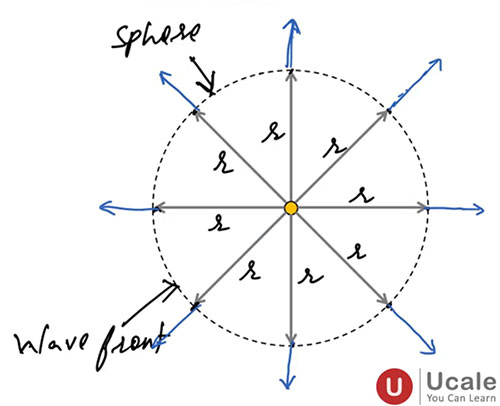
Image Credit: Ucale.org
- Cylindrical Wave Front
- Formed by a line source (e.g., a long slit)
- Waves spread in a cylindrical fashion
- Wave front = expanding cylinder
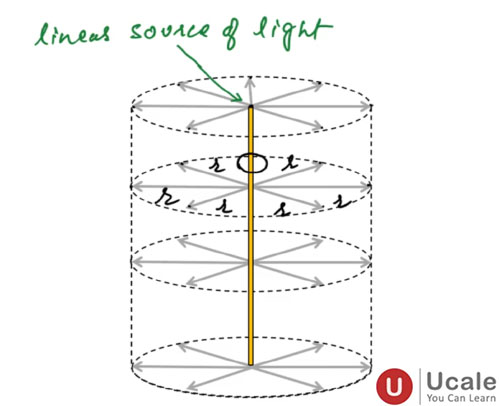
Image Credit: Ucale.org
- Plane Wave Front
- Formed when light from a distant source reaches far away
- Curvature becomes almost zero
- Wave front looks like a flat plane

Image Credit: Ucale.org
No mathematical derivation is required
Wave front is a geometrical concept, so it has no formula for derivation, but it plays a major role in explaining phenomena like:
- Reflection (via Huygens’ principle)
- Refraction
- Diffraction
- Interference
3. Dimensions and Units
A wave front is a surface, so:
- Dimensions: 2-dimensional geometrical surface
- Units: No physical units (it represents a locus, not a measurable quantity)
4. Key Features
- A wave front represents constant phase.
- Wave fronts always move perpendicular to themselves.
- Direction of propagation is given by rays (normal to the wave front).
- Shape of the wave front depends on the source geometry.
- As waves travel larger distances, curved wave fronts become planar.
- Wave fronts are essential in Huygens’ principle.
- All secondary wavelets originate from points on a wave front.
5. Important Concepts / Formulas (Table)
| Concept | Description |
|---|---|
| Wave Front | Locus of points in same phase |
| Spherical Wave Front | From a point source |
| Cylindrical Wave Front | From a line source |
| Plane Wave Front | Far-away spherical wave front approximated as plane |
| Direction of Propagation | Normal to wave front |
6. Conceptual Questions with Solutions
1. Why is a wave front always perpendicular to the direction of wave propagation?
Because wave propagation is along the direction in which phase changes most rapidly. A wave front is a surface of constant phase, so the direction of propagation must be perpendicular to it.
2. Why do spherical wave fronts become plane wave fronts at long distances?
Because the radius of curvature becomes extremely large. A curved surface with very large radius appears flat (plane) over small regions.
3. Can a wave front exist for non-light waves?
Yes. Water, sound, and mechanical waves also have wave fronts. Any wave with phase can have a wave front.
4. Why do wave fronts bend around obstacles?
Because of **diffraction**. Each point on a wave front acts as a source of secondary wavelets, and these spread into the shadow region.
5. Does a wave front exist in a vacuum?
Yes. Electromagnetic waves can travel in vacuum, and wave fronts represent surfaces of constant phase even in vacuum.
6. Why is a wave front curved near the source?
Because waves spread out in all directions from a point source, forming a spherical geometry.
7. What happens to a wave front when light enters a denser medium?
Its speed decreases, but points remain in the same phase. The shape changes according to Snell’s law using Huygens’ principle.
8. Why can plane wave fronts be approximated for sunlight reaching Earth?
Because the Sun is extremely far away, making the curvature negligible at Earth’s surface.
9. Can a wave front be discontinuous?
No. Wave fronts must be continuous since a discontinuity would imply an undefined or abruptly changing phase.
10. Why do we use wave fronts in Huygens’ principle?
They help visualize how waves advance: each point on a wave front emits secondary wavelets that build the next wave front.
11. If two points lie on the same wave front, what is their phase difference?
Zero. They are always in the same phase.
12. Why does the direction of light not depend on the curvature of wave front?
Because direction is determined by the normal to the wave front, which is defined regardless of curvature.
13. How can a plane wave front be produced in a laboratory?
By using: – A point source – A convex lens The lens converts spherical wave fronts into plane ones.
14. Can wave fronts overlap?
Yes. When waves from different sources meet, their wave fronts intersect, producing interference.
15. Why do wave fronts help us understand diffraction patterns?
Wave fronts show how secondary wavelets spread into geometrical shadows, explaining bright and dark diffraction regions.
7. FAQ / Common Misconceptions
1. Misconception: Wave front and wave crest are the same.
Not true. A wave crest is a physical maximum displacement; a wave front is a theoretical surface connecting points of same phase.
2. Misconception: Only spherical wave fronts exist.
Plane and cylindrical wave fronts also exist depending on the source.
3. Misconception: Wave fronts cannot change shape.
Wave fronts change shape when entering different media due to refraction.
4. Misconception: Light rays and wave fronts are unrelated.
Rays are normals to wave fronts. They are geometrically linked.
5. Misconception: A wave front travels faster in denser media.
No. Wave speed decreases in denser media; wavelength adjusts accordingly.
6. Misconception: Plane wave fronts exist only in theory.
Laser beams and sunlight produce practically plane wave fronts.
7. Misconception: Wave fronts cannot overlap.
Interference requires overlapping wave fronts from coherent sources.
8. Misconception: Wave front depends on amplitude.
Wave front depends only on phase, not amplitude.
9. Misconception: Wave fronts cannot bend around corners.
They do bend, due to diffraction.
10. Misconception: Rays represent physical paths.
No. Rays are imaginary lines showing the direction of wave propagation.
8. Practice Questions (with Step-by-Step Solutions)
1. A small bulb acts as a point source. What type of wave front is formed?
Solution:
A point source radiates waves equally in all directions.
→ Wave front = spherical.
2. A distant star emits light that reaches Earth. What wave front is observed?
Solution:
Distance is extremely large → curvature negligible.
→ Wave front = plane.
3. A long straight filament emits light. Identify the wave front.
Solution:
A long filament acts like a line source.
→ Wave front = cylindrical.
4. Why does a convex lens convert spherical wave fronts into plane wave fronts?
Solution:
Because the lens refracts the incoming rays such that:
- The secondary wavelets emerging from the lens have equal path lengths
- Thus they reach a plane surface with the same phase
→ Plane wave front produced.
5. A plane wave front passes through a small aperture. What happens?
Solution:
Due to diffraction, the portion passing through the aperture acts as a new point source.
→ The plane wave front becomes circular (in 2D) or spherical (in 3D).
 Sign in with Google