

1. Concept Overview
When a monochromatic light beam passes through a narrow slit, it spreads out due to diffraction. The screen observes a bright central maximum with dark and bright fringes on both sides.
The central maximum is the largest and brightest region in the diffraction pattern.
We focus on determining its angular width and linear width.
2. Derivation — Angular & Linear Width
In single-slit diffraction, the first minima occur where:
[ a sinθ = ±λ ]
where:
• [a] = width of the slit
• [λ] = wavelength of light
• [θ] = angle of first minima from central axis
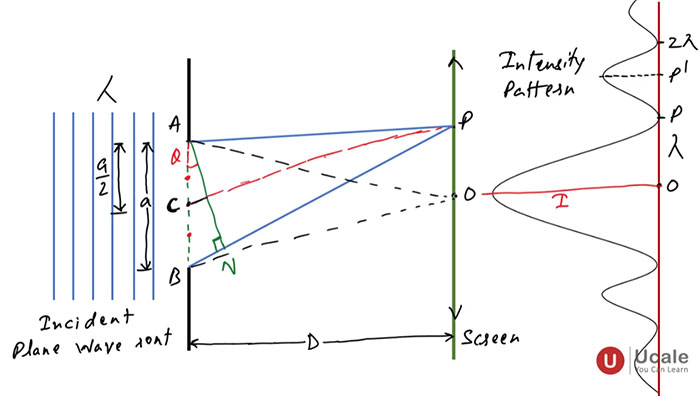
So, first minima positions:
[ θ = ±λ/a ]
Thus, total angular width of the central maximum:
[ Δθ = 2λ/a ]
Now let the screen be at distance [D] from the slit.
For small angles:
[ tanθ ≈ θ = λ/a ]
Distance of first minimum from center on screen:
[ y = D λ / a ]
Thus, total linear width of central maximum:
[ W = 2y = 2D λ / a ]
3. Dimensions & Units
| Quantity | Expression | Dimensions | SI Unit |
|---|---|---|---|
| Angular width | [Δθ = 2λ/a] | Dimensionless | Radians |
| Linear width | [W = 2Dλ/a] | [L] | Metre (m) |
4. Key Features
- Central maximum is twice as wide as other bright fringes.
- Width increases with:
- Increasing wavelength [λ]
- Increasing screen distance [D]
- Width decreases with:
- Increasing slit width [a]
- Explains why diffraction becomes noticeable for very small apertures.
5. Important Formulas (Learn & Reuse)
| Feature | Formula |
|---|---|
| First minima | [a sinθ = λ] |
| Angular width of central max | [Δθ = 2λ/a] |
| Linear width of central max | [W = 2Dλ/a] |
6. Conceptual Questions with Solutions
1. What happens to central maximum if slit width is reduced?
Width increases because [W ∝ 1/a]. Narrow slit → more spreading → wider diffraction pattern.
2. Why is central maximum highest in intensity?
Most of the diffracted light energy goes into the central region as contributions from entire slit aperture add constructively near θ = 0.
3. Why do we see diffraction effects more clearly with longer wavelengths like red light?
Because [Δθ ∝ λ], so red light (higher λ) spreads more → wider central maximum.
4. What happens to central maximum on moving screen farther away?
[W = 2Dλ/a] ⇒ Width increases linearly with D.
5. Why diffraction pattern disappears for very wide slits?
If [a >> λ], then [Δθ = 2λ/a ≈ 0], so light passes nearly straight → negligible diffraction.
6. Why is diffraction pattern continuous unlike interference pattern?
Diffraction comes from **infinite points** within the slit → continuous distribution of intensities.
7. Does central maximum shift if wavelength changes?
No shift in center, only width changes; center is always at geometric axis.
8. Why is diffraction more noticeable for sound than light?
Sound has large wavelength ⇒ greater spreading around obstacles.
9. Does increasing slit width increase intensity of central maximum?
Yes, more light passes; intensity increases but width decreases.
10. How does diffraction relate to resolution in optical instruments?
Large diffraction → large spot size → poor resolution. Minimizing diffraction improves resolving power.
7. FAQ / Common Misconceptions
1. Why doesn’t ray optics predict central maximum?
Ray optics ignores wave nature; diffraction is a wave phenomenon.
2. Central maximum is not bright due to interference. True?
False. It is bright **due to constructive interference** from all parts of the slit.
3. Angular width depends on screen distance. True?
False. [Δθ = 2λ/a] → independent of screen distance.
4. If slit width doubles, width of central maximum doubles. True?
False. [W ∝ 1/a] → width halves.
5. More diffraction occurs when aperture is large. True?
False. Diffraction increases when aperture is **small**.
6. Dark fringes form due to absence of light. True?
False. They form due to **destructive interference**.
7. Diffraction is independent of wavelength. True?
False. It is strongly **dependent on λ**.
8. Does diffraction cause the central maximum to move?
No. Only its **width** changes.
9. Longer wavelength always gives stronger intensity. True?
False. It gives **wider**, not necessarily more intense, maxima.
10. Diffraction effects can be ignored in daily life. True?
False. E.g., hearing sounds behind walls is due to diffraction.
8. Practice Questions (With Step-by-Step Solutions)
Q1. Light of wavelength [600 nm] passes through a slit of width [0.2 mm].
Find angular width of central maximum.
Solution
[Δθ = 2λ/a]
[= 2 × 600×10^-9 / 0.2×10^-3]
[= 6×10^-3 rad]
Q2. For the above setup, screen distance [D = 2 m].
Find linear width.
[W = 2Dλ/a]
[= 2×2×600×10^-9 / 0.2×10^-3]
[= 0.012 m = 1.2 cm]
Q3. What happens to width if slit width becomes [0.4 mm]?
Width becomes half:
[W_new = W/2 = 0.6 cm]
Q4. A central maximum of width [8 mm] is observed when [λ = 500 nm] and [D = 1 m].
Find slit width [a].
[W = 2Dλ/a] ⇒ [a = 2Dλ/W]
[= 2×1×500×10^-9 / 8×10^-3]
[= 1.25×10^-4 m]
Q5. If the width of central maximum doubles, what change must be done in slit width?
Since [W ∝ 1/a], slit width must be halved.
 Sign in with Google