

Concept Overview
Young’s Double Slit Experiment is a famous experiment that proved the wave nature of light.
It demonstrates interference, a phenomenon where two light waves overlap to form a pattern of bright and dark fringes on a screen.
Setup:
- A single slit S acts as a coherent source (same frequency & fixed phase difference).
- Light from S reaches two fine slits A and B placed close to each other.
- Waves emerging from A and B overlap on the screen and produce interference fringes.
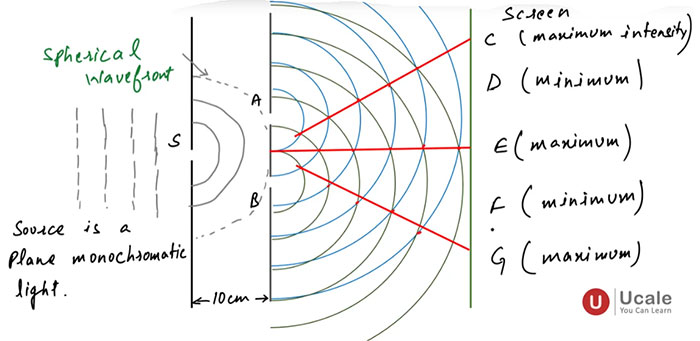
Observation:
- Bright fringes → Constructive interference
(waves from A and B arrive in phase) - Dark fringes → Destructive interference
(waves arrive out of phase by [π], [3π], etc.)
Explanation & Mathematical Derivation
Let:
- Separation between slits A and B = [d]
- Distance between slits and screen = [D] (where [D >> d])
- Wavelength of light = [\lambda]
- Position of a point P on the screen at distance y from the central point O.
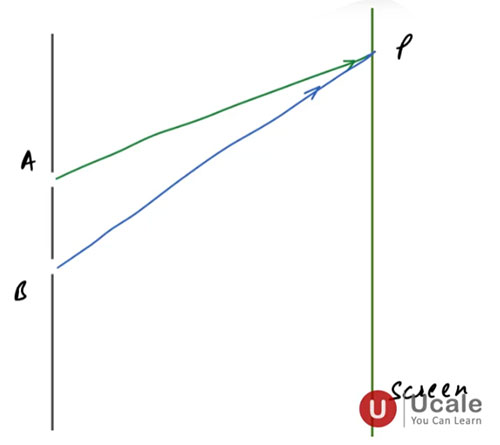
Path difference:
Distance traveled from slit A to P = [AP]
Distance traveled from slit B to P = [BP]
Approx. path difference:
[\Delta x = BP – AP] [= \dfrac{dy}{D}]
Condition for Bright Fringe (constructive interference)
[\Delta x = n\lambda] [\quad] [(n = 0, \pm1, \pm2, \ldots)]
Fringe positions:
[y_n] [= \dfrac{n\lambda D}{d}]
Follow for the detail explanation for Conditions for Constructive and Destructive Interference
Condition for Dark Fringe (destructive interference)
[\Delta x] [= \left(n + \dfrac{1}{2}\right)\lambda]
[y_{n(\text{dark})}] [= \dfrac{\left(n + \frac12\right)\lambda D}{d}]
Fringe Width
Distance between two successive bright (or dark) fringes:
[\beta = \dfrac{\lambda D}{d}]
Dimensions & Units
| Physical Quantity | Expression | Dimensions | SI Unit |
|---|---|---|---|
| Fringe width | [\beta = \dfrac{\lambda D}{d}] | [L] | metre (m) |
| Wavelength | [\lambda] | [L] | metre (m) |
| Slit separation | [d] | [L] | metre (m) |
| Screen distance | [D] | [L] | metre (m) |
Key Features
- Interference pattern forms alternate bright & dark fringes.
- Central maximum is always bright.
- Fringe width increases if:
- Wavelength increases
- Distance to screen increases
- Fringe width decreases if:
- Slit separation increases
- Confirms the wave nature of light.
Important Formulas
| Concept | Formula |
|---|---|
| Path difference | [\Delta x = \dfrac{d,y}{D}] |
| Bright fringe condition | [\Delta x = n\lambda] |
| Dark fringe condition | [\Delta x] [= \left(n+\dfrac12\right)\lambda] |
| Fringe width | [\beta = \dfrac{\lambda D}{d}] |
Conceptual Questions with Solutions
1. Why is slit S used before slits A and B?
It ensures that slits A and B receive light from the same source → Light becomes coherent → Stable interference pattern forms.
2. What would happen if d is increased?
Fringe width [\beta = \dfrac{\lambda D}{d}] decreases → fringes come closer.
3. What determines the colour of fringes?
Wavelength [\lambda]. Different colours → different fringe spacing.
4. Why is central fringe always bright?
Path difference at the midpoint is zero → constructive interference occurs.
5. Does intensity ever become negative in dark fringes?
No. Dark fringe means **minimum** intensity, not negative intensity.
6. What if the light was incoherent?
Interference pattern would keep shifting → average pattern disappears → only uniform illumination.
7. Why must d << D?
So that both waves meet nearly parallel at the screen → valid approximations.
8. Why does interference not occur with one slit?
Only one wave → no superposition → no alternate bright/dark bands.
9. Will pattern disappear if one slit is closed?
Yes → No interference → uniform brightness on the screen.
10. What happens if the wavelength is doubled?
Fringe width doubles → pattern becomes more spread out.
11. Why are fringes equally spaced?
Because fringe width depends on constant parameters [\lambda, D, d].
12. What is fringe shift?
Shifting of entire pattern due to a change in optical path (e.g., adding glass plate).
13. Why are fringes wider with monochromatic light?
Single wavelength = stable & clearly separated bright/dark fringes.
14. Do fringes form behind slits A and B only?
Yes, only in the region where light from both slits overlaps.
15. Can interference occur with sound waves?
Yes! Interference is a property of **any wave**, not just light.
FAQ / Common Misconceptions
1. Bright fringes are just images of slits.
No. They result from **wave interference**, not geometrical projection.
2. Central bright fringe belongs to slit A or B?
Neither — it is due to **equal path** from both slits.
3. Fringe width depends on screen brightness.
Not at all. It depends only on [\lambda], [D], [d].
4. Dark fringes mean light is absent.
Light is present but cancels due to destructive interference.
5. Only light waves can interfere.
False — all waves do (sound, water, EM, etc.).
6. Interference and diffraction are same.
They are related but **not** the same. Diffraction = bending at edges; interference = superposition.
7. Intensity must remain constant everywhere.
Superposition causes variation → interference pattern forms.
8. Slits must be extremely wide.
No — slits must be **narrow** so each acts as a secondary wave source.
9. Only equal amplitudes produce interference.
Different amplitudes still interfere — only visibility decreases.
10. The interference pattern is permanent.
No — depends on stability of coherence and experimental conditions.
Practice Questions (with Step-by-Step Solutions)
Q1. Light of wavelength [600nm] falls on two slits separated by [0.2mm]. Screen distance = [1m]. Calculate fringe width.
Solution:
[\beta = \dfrac{\lambda D}{d}] [= \dfrac{600 \times 10^{-9} \times 1}{0.2 \times 10^{-3}}] [= 3 \times 10^{-3} \text{ m}] [= 3 \text{ mm}]
Q2. Find position of 4th bright fringe on screen with same data.
[y_4 = \dfrac{4\lambda D}{d}] [= 4 \times 3\text{ mm}] [= 12 \text{ mm}]
Q3. What slit separation will give [1mm] fringe width in above experiment?
[d = \dfrac{\lambda D}{\beta}] [= \dfrac{600 \times 10^{-9} \times 1}{1 \times 10^{-3}}] [= 6 \times 10^{-4} \text{ m}] [= 0.6 \text{ mm}]
Q4. Light is changed to wavelength [450nm]. Find new fringe width.
[\beta] [= \dfrac{450 \times 10^{-9} \times 1}{0.2 \times 10^{-3}}] [= 2.25 \text{ mm}]
Q5. If one slit is covered with a glass plate that causes an extra path difference of [\lambda/2], what happens?
Solution:
Central fringe becomes dark → Entire pattern shifts by half a fringe width.
 Sign in with Google